KU student says she’s “just surviving” as AI shortcuts reshape coursework
LAWRENCE, Kan. — It was almost 11 p.m. when Addey Wade, a sophomore journalism student at the University of Kansas, opened ChatGPT in a new tab. She had a 10-page essay due at midnight, a 40-hour-a-week job, and a full course load. Burned out and out of time, she pasted the prompt in.
Wade is not alone. A generation of college students has come to treat coursework as a checklist of tasks to clear rather than material to learn. A 2025 Inside Higher Ed survey found that 85 percent of college students used generative AI for schoolwork in the past year. At KU’s Counseling and Psychological Services, staff say they’re seeing the cost, burnout, anxiety and a quiet sense among students that something has gone missing.
Wade woke up at 9 a.m. most days to keep up with 17 credit hours. She worked double shifts to be able to pay for housing and groceries, and tries to maintain her relationships with her friends in between. By the time she sits down to do her coursework, she said, there’s nothing left.
“I am just surviving. I am overwhelmed by what life is throwing at me,” Wade said. “Allowing AI to help me every once in a while is not wrong, I just want to graduate.”
A 2026 USC study surveyed 1,000 U.S. college students, and found that students use AI as a way a shortcut for quick answers that do not require a lot of work. A separate study from researchers at Wharton found that students who use AI scored higher on practice problems but learned less in the long run.
Wade turned to AI to assist her with an assignment that she did not understand completely, and it is too late to ask her professor for assistance. She pasted her prompt and notes into ChatGPT and asked it to simplify the task or build an outline. She did not submit assignments that were entirely AI-generated, she said. She uses it to spark ideas and get a better understanding of what she is supposed to do.
The cost is showing up across Wade’s life. She skipped meals because there are not enough hours in the day, found herself wanting to be alone, and said her physical and mental health have both taken a hit since college got harder. She sought medical help to manage her mental health. Friends she used to enjoy spending time with have started to feel like a hassle.
Wade’s experience matches what national data has tracked for years. A 2024-2025 study found 37 percent of U.S. college students screened positive for moderate or severe depression, and 33 percent for anxiety. At KU’s Counseling and Psychological Services, staff are seeing the same pattern.
Sally Burns, outreach coordinator and embedded clinician at KU’s Counseling and Psychological Services, said students typically experience their greatest stress at the end of the semester. In her 13 years in college counseling, end-of-semester demand has always spiked, she said. CAPS expanded its drop-in availability during the last two weeks of every semester to meet rising demand, she said.
When students describe burnout, Burns said, they often talk about feeling unmotivated and pulling back from self-care. This is the same feeling that Wade described in her own life. Burns said the pressure to perform for GPA, jobs and graduation increases stress and anxiety, which in turn affects concentration and self-care.
She also mentioned seeing something new this year. Some students are using AI not just for coursework, but for emotional support, advice and guidance. Students turn to chatbots in moments they might once have brought to a friend or a counselor.
KU CAPS offers same-day drop-in support from 10 a.m. to 3 p.m. weekdays at Watkins Health Building. First-time appointments are covered by the campus wellness fee. Students can also access Mantra Health, a free 24-hour mental health service available to KU students.
Months after that 11 p.m. paste into ChatGPT, Wade is still pushing through to graduation. But she said the system she’s pushing through isn’t really working.
“College’s structure fails to see the main goal,” Wade said. “I’m scared I am not going to get a job to support myself.”
Script:
[0:00]
It was almost 11 p.m. when Addey Wade, a sophomore at KU, opened ChatGPT to finish a 10-page
essay due at midnight.
[0:08]
Wade works a 40-hour-a-week job, carries 17 credit hours, and says by the time she sits down to
do schoolwork, there’s nothing left.
[0:18]
She isn’t alone. A national survey this year found 85 percent of college students used AI for
coursework.
[0:25]
At KU’s Counseling and Psychological Services, staff say they’re seeing the cost — burnout,
anxiety, and students pulling back from the people and habits that used to keep them going.
[0:34]
Outreach coordinator Sally Burns says some students are now using AI not just for
coursework, but for emotional support — turning to chatbots in moments they might once have
brought to a friend.
[0:44]
For Wade, college has started to feel like a checklist of tasks to clear. She says she’s just
trying to graduate.
[0:52]
But she’s not sure the system she’s pushing through is preparing her for what comes next.
Contact Info:
Addey Wade
813-964-9495
Sally Burns
sally.burns@ku.edu
Work Cited:
Insider Ed Survey
USC Study
Wharton Study
Mantra Health
High 5 Study
Download Article - CLICK HERE
Hello, this project was created by Addey Wade, Olivia Cooper, and Mia Ramerz and I am excited to finally show our semester project, Chiefs Dynasty Data. In this project, we analyzed the Kansas City Chiefs 2023 season to understand what factors led to their Super Bowl win. We focused on turning raw game data-like turnovers, passing yards, and defensive performance-into a clear and compelling story that explains not just what happened, but how it happened.
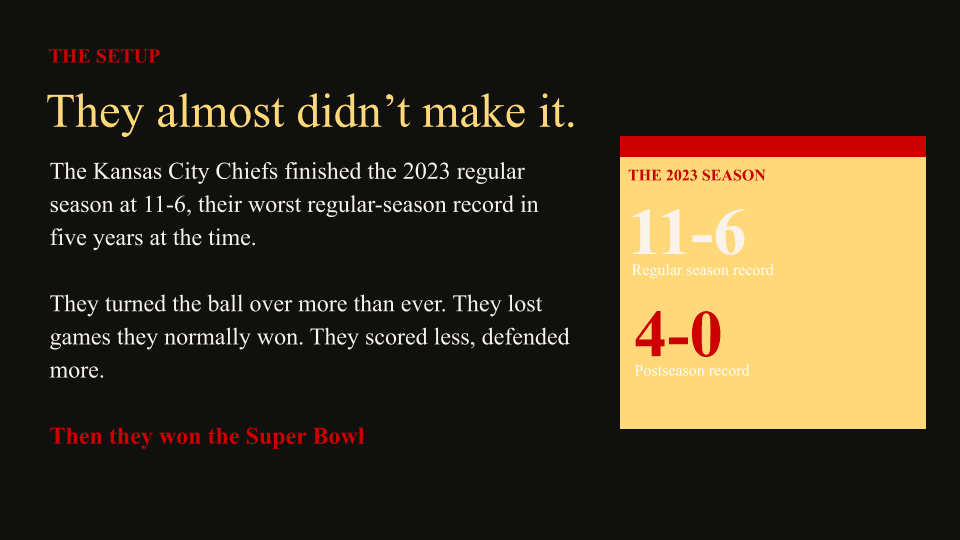
They almost didn’t make it. The chiefs finished the regular season 11 and 6, which was their worst record in five years at the time. They turned the ball over more than usual, lost games they typically would win, and their offense wasn't as dominant as in previous seasons. At many points, they didn't look like a championship team. But despite those struggles, they went 4 and 0 in the postseason and ended the season as Super Bowl champions. So the question we wanted to answer was: what changed?
Part one of our analysis focuses on turnovers, which were one of the biggest factors affecting their regular-season performance.
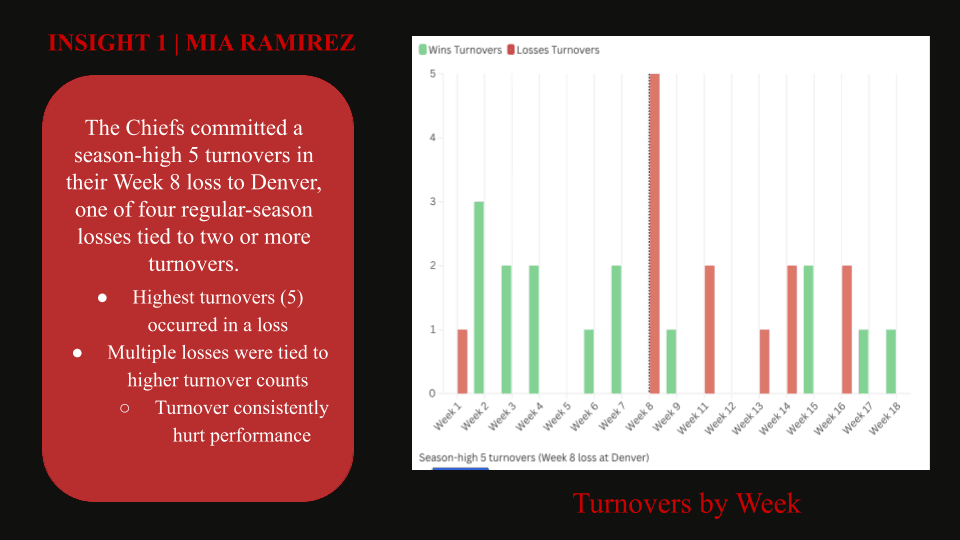
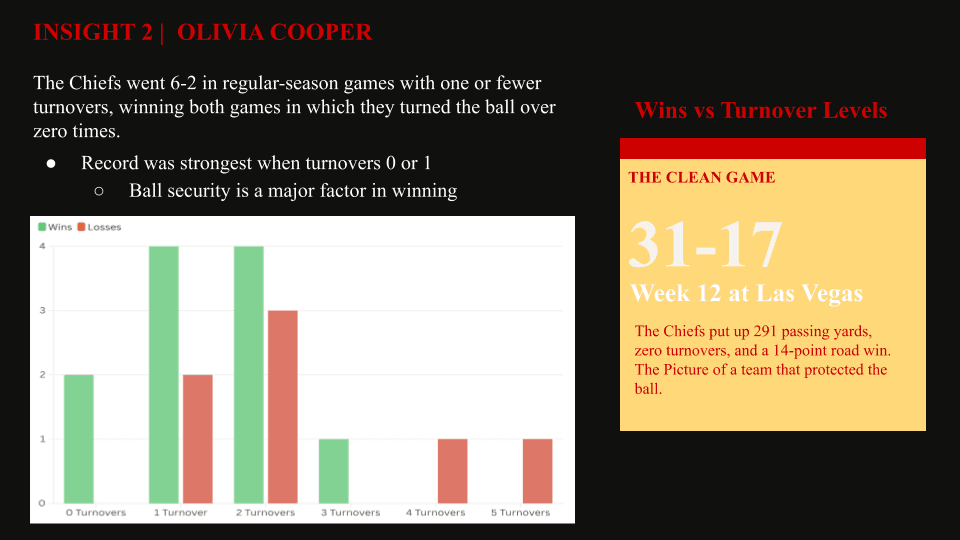
The data shows that turnovers had a clear negative impact on the Chiefs success. Their worst game came in Week 8 against Denver, where they committed five turnovers and lost. More broadly, several of their losses were tied to games where they had multiple turnovers. This pattern tells us that when the Chiefs made mistakes and gave the ball away, it directly hurt their chances of winning.
On the other hand, when the Chiefs protected the ball, their performance improved significantly. They went 6 and 2 in games where they had one or fewer turnovers, and they won both games where they had zero turnovers. This highlights how important ball security was-it wasn't just helpful, it was one of the strongest predictors of whether they would win or lose.
A great example of this is their Week 12 win against Las Vegas. In that game the Chiefs had zero turnovers, 291 passing yards, and won by 14 points on the road. This game represents what the team looked like at their best-efficient offense, strong execution, and no costly mistakes.
Next, we looked at the passing game, which played a major role in keeping the team competitive throughout the season.
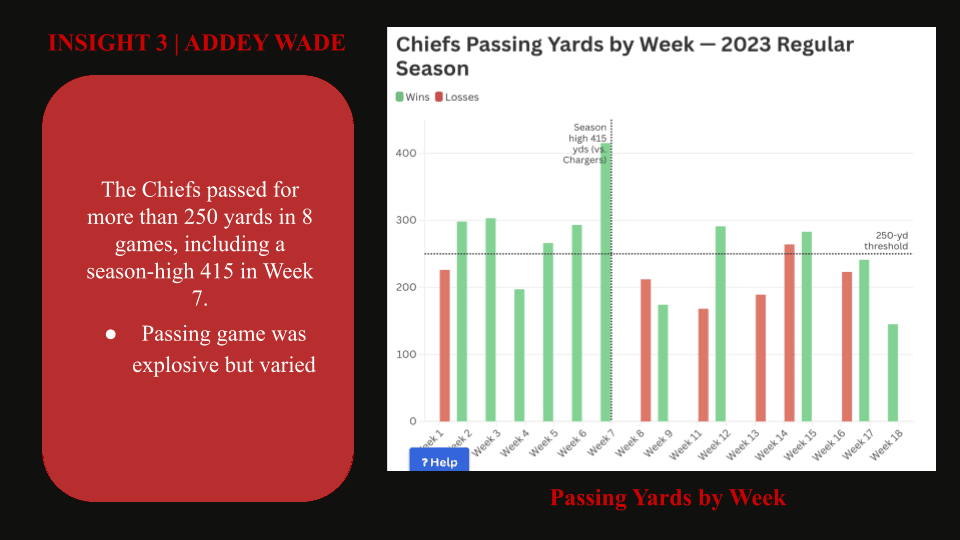
The Chiefs passing game was strong, but not always consistent. They had eight games with over 250 passing yards, including a season-high of 415 yards in week 7. This shows their offensive potential and ability to produce big plays. However, the variation between games also helps explain why their regular season performance was inconsistent-some weeks they were explosive, and other weeks they struggled.
When we moved into the postseason, the data showed a clear shift. This is where the Chiefs flipped the script.
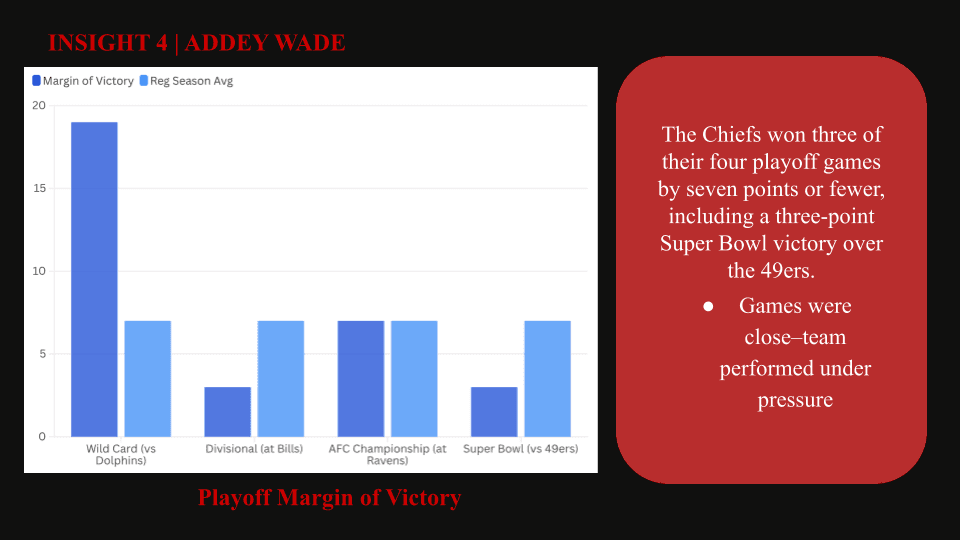
In the playoffs, the games were much closer-but the Chiefs performed at their best under pressure. They won their four playoff games by seven points or fewer, including a three-point Super Bowl win over the 49ers. Instead of dominating opponents, they consistently executed in key moments, which allowed them to win tight games.
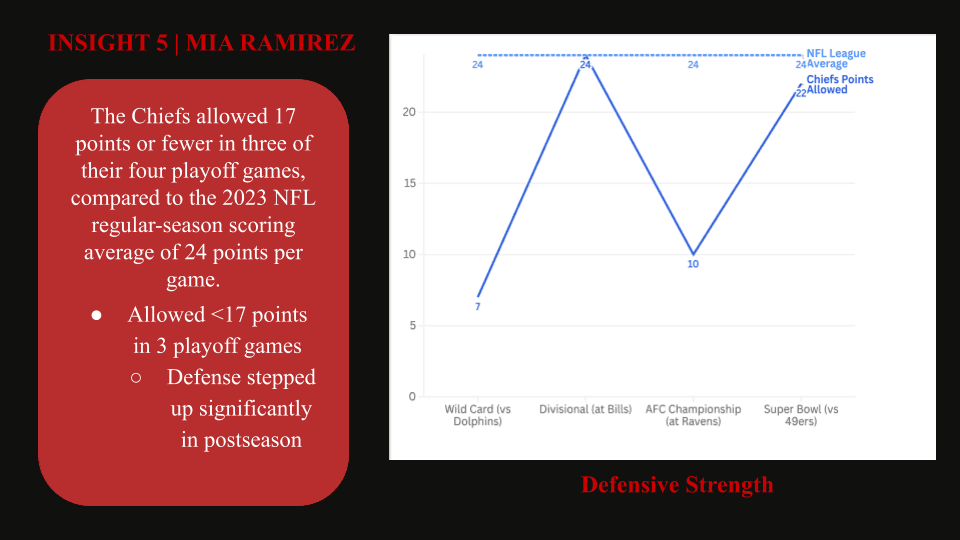
Defensively, the team improved significantly in the postseason. They allowed 17 points or fewer in three of their four playoff games, which is well below the NVFL average of about 24 points per game. This shows that their defense stepped up at the most important time and played a major role in their success.
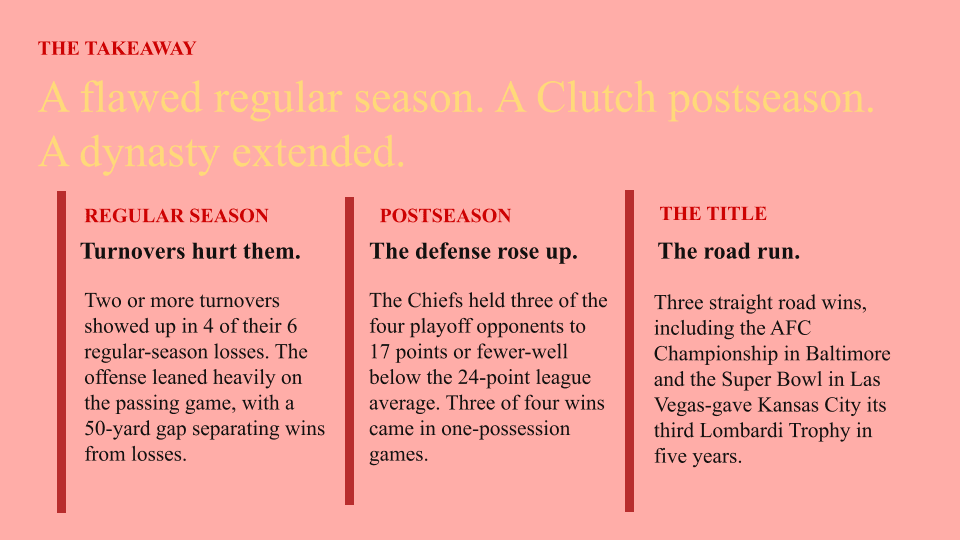
When we combine all these insights, the overall story becomes clear. During the regular season, the Chiefs struggled with turnovers and inconsistency, especially on offense. But in the playoffs, they adapted. They reduced mistakes, improved defensively, and found ways to win close games-even in high-pressure situations and on the road. This shows that their championship run wasn't about being dominant-it was about being disciplined, efficient, and clutch when it mattered most.
In conclusion, this project demonstrates how data can be used to tell a deeper story in sports. By analyzing key performance metrics, we were able to identify the turning points that defined the Chiefs season. Ultimately, their success shows that championships are not just about talent-they're about adapting, improving, and performing when it matters most.
Thank you